Opening up an apparel business seems exciting. But there are many challenges new brands face in managing production requirements. Many startups enter the fashion business with a huge bunch of ideas, but may find the real world scenarios stressful and disorienting in more ways than one.. One of the key ideas that every startup must understand is the MOQ in apparel manufacturing.
In the apparel industry, manufacturers often ask the brand to place a minimum order of units. It could be related to design, colour, or style before the production actually begins. Those startups that are at an early stage and have smaller budgets may feel all this to be burdensome.
This blog will explain what MOQ is and why manufacturers impose them, and how startups in apparel manufacturing can leverage the idea of MOQ for the best utilisation of resources.
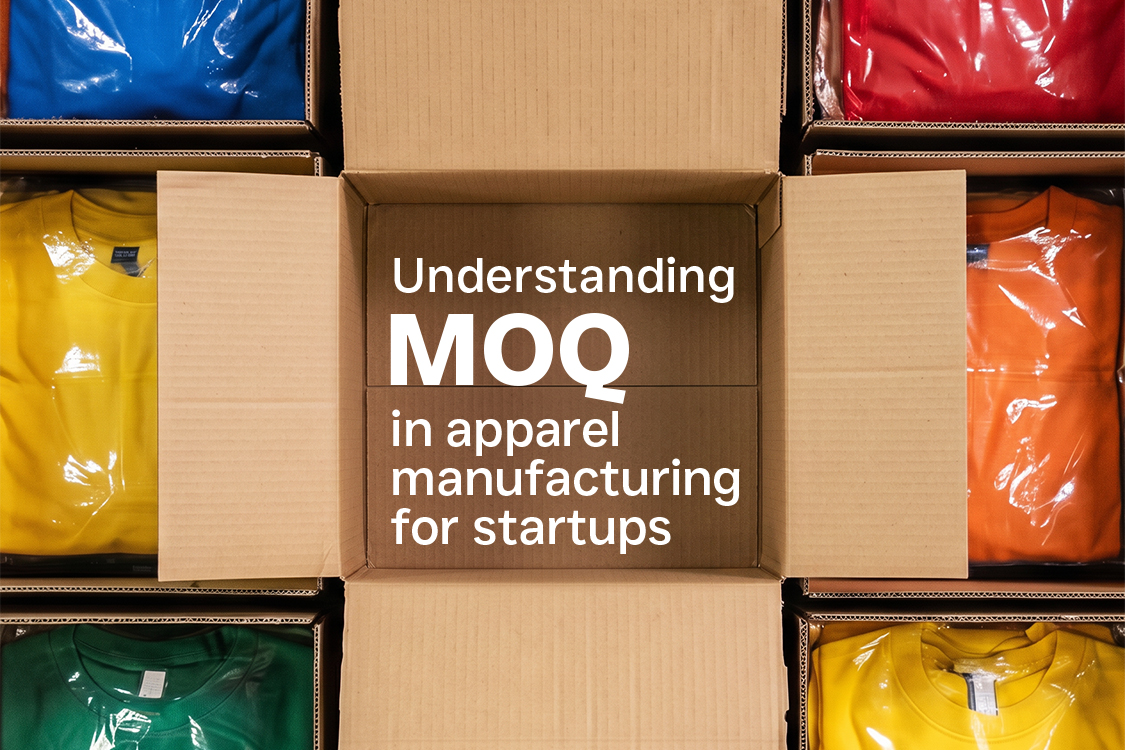
MOQ stands for Minimum Order Quantity. It refers to the smallest number of units that a manufacturer is willing to produce for a specific order given by a brand.
For example, clothing manufacturers in Jordan may require a startup to order at least 500 t-shirts of every colour. There may be another supplier who would require a MOQ of 700 units of a particular style of pants.
The main idea behind applying MOQ in apparel manufacturing is to make sure that the production cost remains effective and efficient. A huge amount of investment has to be made in terms of time, labour, machinery, fabrics, and quality checks every day. If very small quantities are produced, it will not be cost-efficient for manufacturers to produce them. Thus, the businesses analyze these factors before approaching suppliers for the process of cloth production.
Every factory operating has to incur two types of costs, namely fixed costs and operating expenses.
Additionally, apparel manufacturing requires a process of flow production. The apparel has to move through several stages, starting from
If the order quantities are small, it will disrupt the workflow. Therefore, the startups prefer MOQ in apparel manufacturing so that there can be better resource utilisation.
The concept of MOQs benefits startups in several ways.
Despite the benefits, startups also have to go through a series of difficulties while dealing with MOQ in apparel manufacturing.
But this does not imply that startups cannot overcome these MOQ-related challenges. What the startups can do is start with limited design collections. It could reduce inventory management risks and help the brand test market demand.
There are also suppliers in the market that are willing to work with startups and small businesses. These are the manufacturers that provide for smaller production units.
Thus, selecting the right supplier becomes one of the most important decisions for startups to attain clothing manufacturer minimum order quantity requirements.
A comprehensive understanding of MOQs is not just necessary but also a crucial condition for startups entering the apparel industry. The key to successful startups lies in balancing the production costs along with the market demand. This can be achieved by choosing the correct set of manufacturers as partners, who can align with the business goals of the brand. With the right strategies, these startups can fully navigate the production challenges and create profitable brands.
Are you also looking forward to levelling up your game in the apparel industry? Reach out to Classic Fashion today and tighten your grip in the market.
1. What is MOQ?
MOQ stands for minimum order quantity. It is the minimum number of units that manufacturers require to produce.
2. Why do manufacturers impose MOQs?
Manufacturers impose MOQs to cover production costs and also to maintain efficiency in operations.
3. How can startups in apparel manufacturing reduce inventory risk?
Startups can reduce inventory risks by launching limited collections and forecasting demand to prevent overstocking.