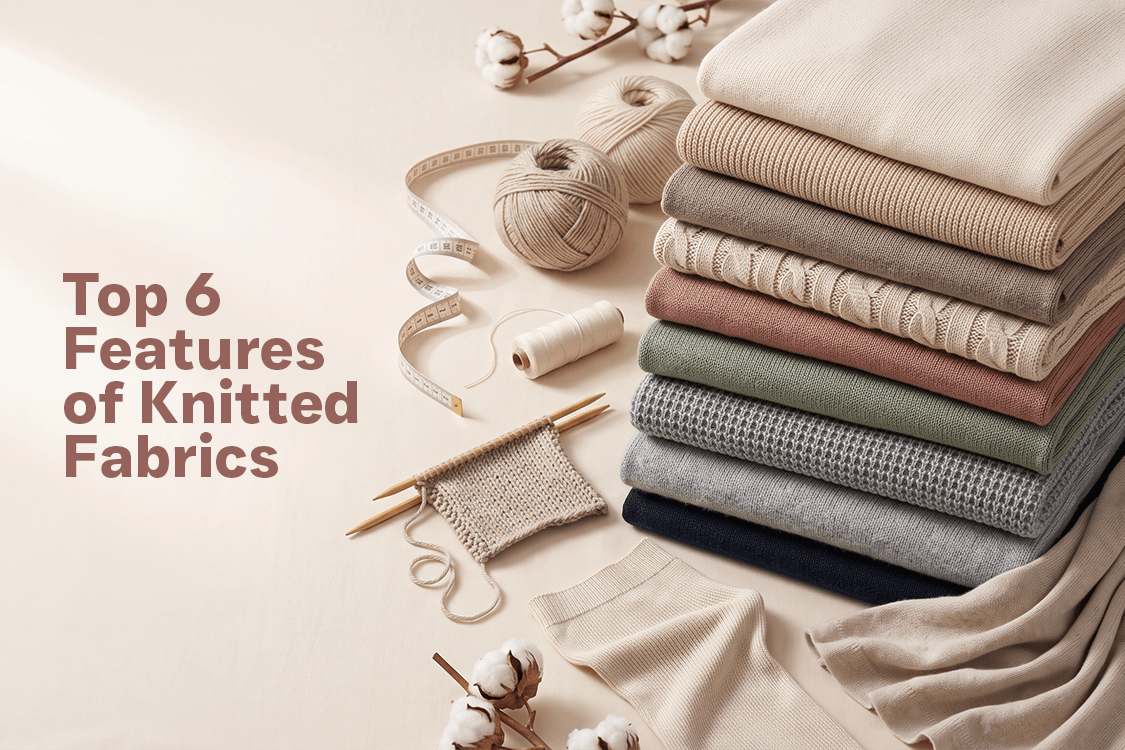
Ever think why your pullover feels like a warm hug on a cold day? Or your socks fit both you and your friend perfectly? Chances are they are made up of knitted fabric.
It’s magical how a single continuous thread is looped over and over again to create a material that adjusts itself as per your body structure, breathes when you need to and feels good against your skin. It is different from woven fabrics. While woven fabrics have crisscrossed threads like a tic-tac-toe board, knitted fabrics are made up of interlocking loops.
Want to know what makes a knitted fabric so special? Let’s understand the features of knitted fabric and how it can help you with your business.
Yarns are the primary ingredients of knitted fabrics. These yarns are intermeshed to form loops using knitting. This unique mesh-like structure offers flexibility and durability to the fabrics. While mostly women’s fabrics are tailored perfectly to your body type and can feel tight on your skin, knitted fabrics feel like some love to the body.
Mostly, knitwear manufacturers used to make socks, hats, and other forms of fitting apparel from knitted fabrics. The quality of the yarn and knitting technique determines fabric’s weight, durability and other performance features.
These yarns have been around us for quite a long time now. It was first used by the people of Egypt and the Middle East. With time, knitting became an important skill in Europe. Then came the Industrial Revolution that gifted us with machines to make the process whole lot faster and easier. In the 20th century, designers like Jean Patou and Coco Chanel launched their fashionwear with knitted fabric.
In the 1960s, patterns were developed in knitwear. By the time of 1980s, knitting fabric evolved from being a comfort zone to people to enter all aspects- from sportswear to high fashion.
So, what’s more to the knitted fabrics other than comfort and flexibility? Let’s breakdown the six features that make knitted fabric your wardrobe favorite.
Knitted fabrics always have space for all those extra inches in your body. They have loops instead of crisscrossing threads that make it stretchier. Pull on a loop and you can see how fast it bounces back. That’s why your leggings hug your curves, and your favorite pullover doesn’t feel harsh. If you’re a plus sized person like me, this feature of knitted wear is what makes it a go-to choice for us in active wears.
Ever wondered why some fabrics make you uncomfortable and all sweaty? This is not the problem with knitted fabrics, though.
These fabrics have tiny little loops leaving gaps between them that allow the flow of air through the fabric, basically a built-in ventilation in your cloths. Even when you wear 4 layers of sweater in winters, it still doesn’t make you puffing and blowing for air.
In a chilled winter morning, your stripped sweater feels like a warm hug. This is because yarns are naturally soft and fluffy. Moreover, the looped structure of knitted fabrics offers a cushiony surface as yarns are not pulled taut unlike weaving. The yarns are weaved with less tension and more softly that evokes the cozy, huggable feel we all love in sweaters and soft-tees.
Imagine a cloth so wrinkle-resistant that you don’t have to press it every time you wear it. Yes, that’s exactly what knitted fabrics are. Knitted loops offer a built-in flexibility that helps the fabric to not hold creases and folds. Toss it into your almirah, sit on it or scrunch it in your bag pack- it will still be the same with no wrinkles. Basically, it’s your low maintenance friend in the world of fabrics.
As knitted fabrics move and flex, they generally take your body’s shape instead of sitting stiffly. This feature of knitted fabrics makes draping beautiful, skimming the curves, instead of appearing boxy. It’s a big reason why many designers go for knits whenever they try to make something look effortless yet flattering.
Mostly, we wear knitted clothes in winters, right? The same breathable fabric then traps warmth inside, making it work like insulators. Basically, while a loose loop breathes and cools, a tight knit traps heat. Same structure, different jobs depending on how it’s made.
Though knitted fabrics are a joy to wear, they come with their own set of quirks on the production floor. If you’re manufacturing with knits, here are some key things you need to remember:
Yarns can get distorted and curve at the edges if not handled carefully during cutting. It’s important to maintain a proper tension control and let the fabrics relax before cutting to avoid sizing issues.
Regular sewing needles can snag and damage knit loops. Rather, you can use a ballpoint or stretch needle for sewing and stitches designed for stretch (zigzag stitches). As a knitwear apparel manufacturer, keep in mind to make it seem intact and flexible, instead of popping or puckering.
The feature of knitted fabrics that makes it durable due to relaxed loops also makes it shrink more than woven ones. Take that in note while sewing the fabric to avoid costly fit issues later.
Based on the yarn and knit type, some fabrics are prone to pilling with wear and washing. Run durability tests before mass production to set the right quality expectations and choose the right yarn blends.
So, there you have it: the loops, the stretch, the breathability, and every other thing that makes knitted fabric the MVP of our closets. From cozy sweaters to perfect beachwear, knitted fabrics have moved mountains in the last few years.
Whether you’re a designer picking your next fabric, a manufacturer fine-tuning the process, or just someone who loves comfy t-shirts, knitted fabrics come in handy. Small loops formed with a continuous thread create some big impact in the clothing industry. So next time you wear something soft and stretchy, just know it’s not magic. It’s just really smart engineering, one loop at a time.
To know more about smart engineering behind your beautiful clothes, connect with us at info@classicfashion.com.
Knitted fabrics are extremely stretchable, breathable, and offer flexibility to your clothes. When knitted loosely, it offers a cooling effect; when knitted tightly, it works as an insulator. They are also wrinkle resistant that makes them a perfect choice for regular wear.
Knit fabrics can be broadly classified into weft knits and warp knits. Weft knits run horizontally across the fabric, and in warp knits, yarns go vertically across the length.
Knitted fabrics are looping-based textile structures that can be made from any fibers like cotton, wool, silk, and synthetic fibers.
The most expensive fabric in the world is Vicuna wool, often called the “fiber of the gods”.