We all love to flaunt denims with tops and shirts quite frequently, for they go with everything. Denims are forever loved, as they are strong and durable fabrics that also make a great fashion statement. However, for a denim clothing company, it thus becomes even more important to ensure quality fabric for customers to be totally satisfied. If the quality is not controlled at every step of the production process, the final product can look uneven, fade badly or lose shape after washing. Hence, every denimwear company must follow strong quality control practices to achieve stable fabric, ensure fewer returns and customer complaints, and create a better brand reputation.
In this blog, we will list the seven most important quality control practices that every denimwear company should follow carefully.
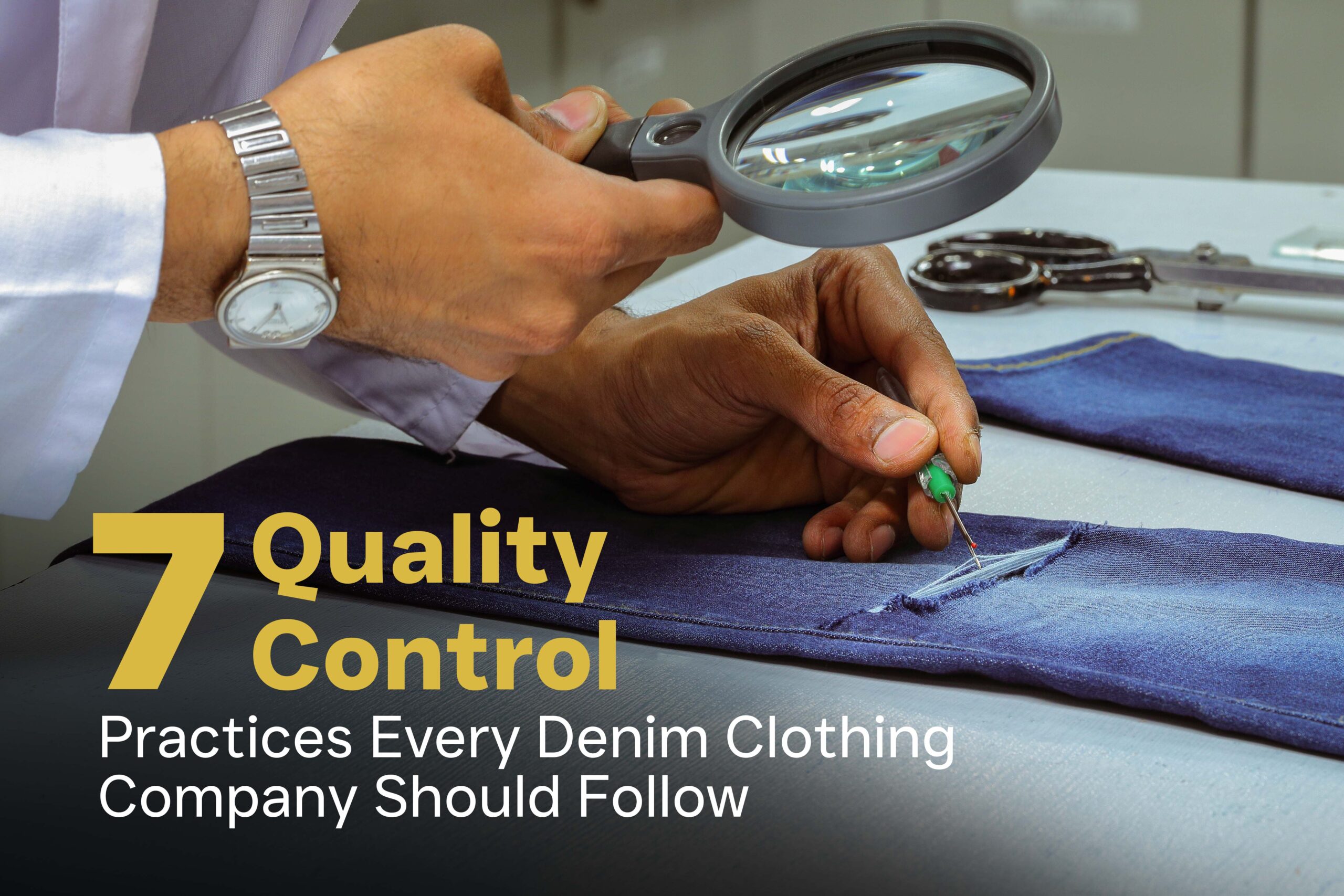
The first step for every denim manufacturing company is to check the fabric before it gets to the cutting floor. Denim may have many natural problems, like –
Hence, the denim clothing company needs to check every roll of fabric before using it. A simple 4-step inspection system can help.
You should always check for –
When these problems are found in the very beginning, you can save time and money and also avoid wasted fabric.
Hence, every denim manufacturer in Jordan should test their products for –
This helps to ensure that the cutting markers are placed at the correct places and the final sizes are matched to the requirements of the customer.
Many b2b clothing manufacturers will usually do this testing automatically before sending the fabric to the sewing unit.
Washing and finishing are the key processes that create the actual beauty of the denimwear. Stone wash, enzyme wash, sandblast, and vintage effects: all these treatments change the final look of the denim.
However, a wash process lacking in key parameters can also create quality-related problems for the fabric.
Some of the errors that can be caused by a deficient washing process include –
To avoid this, a denim company should follow these tips –
Before bulk production, test washes should be done to match the approved sample.
Denim is thick, so stitching it is not that easy. Poor stitching is likely to break soon and give rise to complaints by customers. Thus, every denim manufacturer in Jordan should check these parameters of stitching –
Quality teams should do seam strength tests on sample fabrics.
Some key areas to focus on while testing are –
A stronger stitch means longer garment life.
Even if the fabric and stitching are of good quality, wrong sizing can ruin production. Hence, every batch must be carefully measured, for which a measurement chart should be prepared before production. Key areas to check are the waist, hips, and inseam. Rise, thigh width and hem opening. Many reliable b2b clothing manufacturers run 100% measurement checks on the first pieces of each size, before approving bulk production.
The shade of denim can change even within the same roll. When many rolls are used to sew one piece of apparel, the colour can look mismatched. To avoid this, every denim clothing company should conduct shade grouping.
Here is how shade grouping is done –
Every lot should also be checked under daylight, fluorescent light and yellow light. This helps to ensure the uniformity of colour on the shop floors and in stores.
Before shipping, a final inspection should be done on the finished products. This includes checking the overall appearance of the fabric, stitching mistakes, stains or dirt, broken needles or metal parts, correct labels and size tags and correct folding and packing.
Denim products may look simple from the outside, but they demand strict quality control measures inside the factory. Every denim clothing company should watch all steps from fabric inspection to final packing carefully, as discussed in the seven tips in this blog.